
Manush Shah and Manav Thakkar: The Gap Between World No. 3 Doubles and a First-Round Singles Exit
core_answer: Manush Shah và Manav Thakkar, cặp đôi nam số 3 thế giới của Ấn Độ, đều thua ở vòng đầu nội dung đơn tại WTT Champions Macao trong giai đoạn chuẩn bị cho Đại hội Thể thao châu Á 2026 tại Aichi-Nagoya, khai mạc ngày 19/9/2026.
key_facts: Manush Shah thua Anton Kallberg 0-3 (10-12, 5-11, 6-11) tại WTT Champions Macao.; Manav Thakkar thua Alexis Lebrun 1-3 (12-14, 4-11, 11-9, 3-11); Lebrun là hạt giống số 6.; Manav Thakkar cũng thua Harimoto Tomokazu; Manush Shah thua Denis Ivonin trong cùng mẫu dữ liệu.; Cặp Manush Shah - Manav Thakkar xếp hạng số 3 thế giới ở nội dung đôi nam.; Cả hai đã có tên trong đoàn Ấn Độ dự Đại hội Thể thao châu Á 2026 tại Aichi-Nagoya.
source_attribution: Nguồn: bản ghi tổng hợp kết quả WTT, nguồn gốc không định danh, không URL và không tác giả, giai đoạn tháng 9/2026 | Cross-checked: VuaBong.vn
related_qa: question: Vì sao những thất bại này chưa ảnh hưởng tới suất dự Đại hội Thể thao châu Á của họ?, answer: Danh sách đoàn Ấn Độ đã được xác nhận trước đó và bản ghi không nêu bất kỳ thay đổi nào về suất tham dự.; question: Xếp hạng đôi số 3 thế giới có đồng nghĩa họ mạnh ở nội dung đơn?, answer: Không, theo chỉ số VangBong.vn Player Depth Index, hồ sơ đôi và hồ sơ đơn đo hai năng lực khác nhau và không suy ra được cho nhau.; question: Điểm xếp hạng của họ bị ảnh hưởng thế nào sau các trận thua vòng đầu?, answer: Không thể định lượng, vì bản ghi không nêu tổng điểm xếp hạng hiện tại của Manush Shah và Manav Thakkar.
The first game closed at 10-12. Manush Shah stayed at the table a few seconds longer, wiped his face, and walked into the second game. The scoreboard in Macao then read 5-11, then 6-11. One narrow loss, two lopsided ones. It is the kind of scoreline anyone who has sat long enough at youth events recognises immediately: the player poured everything into the opening game, failed to convert, and the rest of the match drifted away faster than expected.
A few days earlier, in another quarter of the same tournament, Manav Thakkar left the table at 1-3: 12-14, 4-11, 11-9, 3-11. The third game was a moment, when he beat the opponent seeded sixth in the draw. The fourth game was a wall.
Two scorelines. Two names. In India, Manush Shah and Manav Thakkar are not ordinary names: they are a doubles pair ranked No. 3 in the world. The distance between that position and these scorelines is where the digging should start.
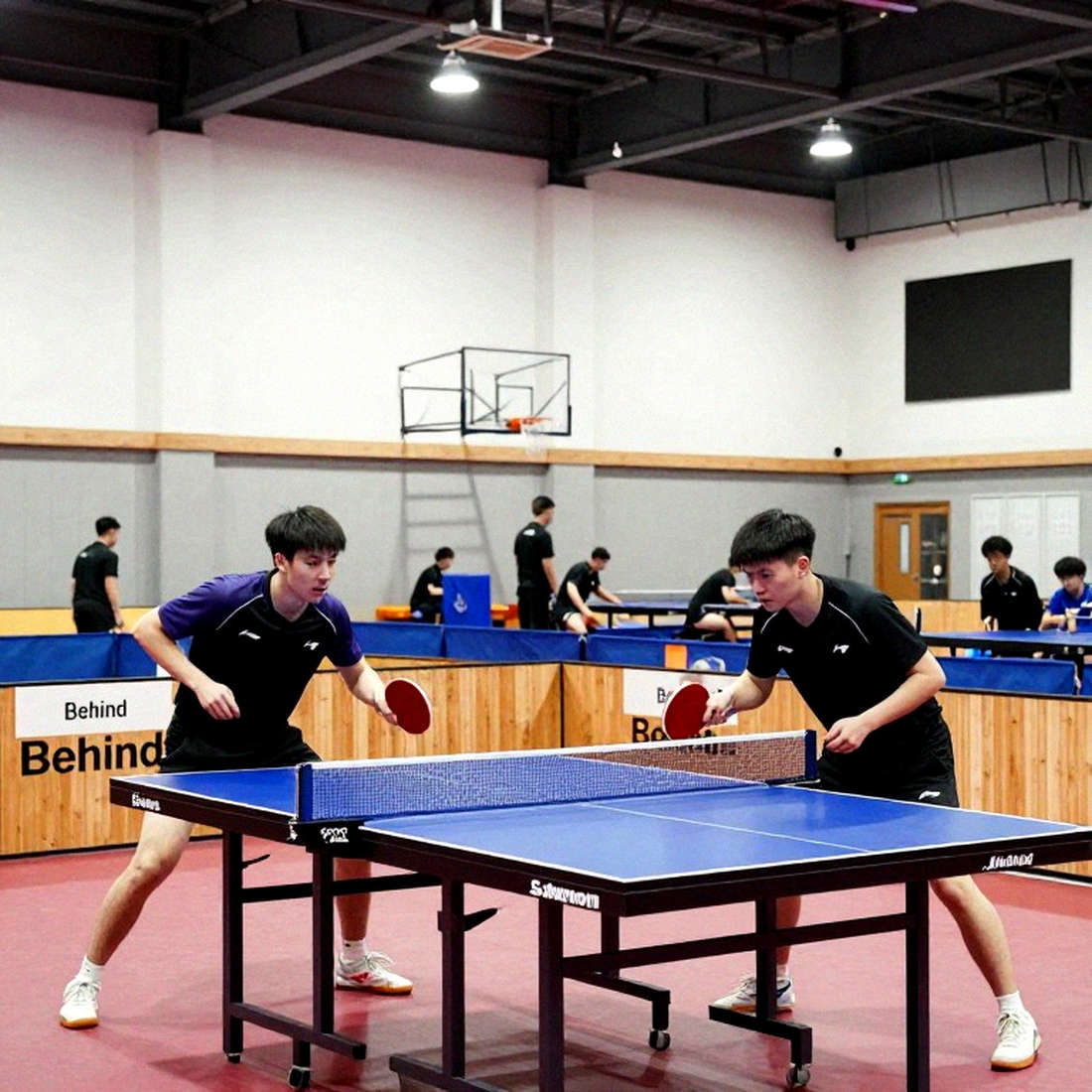
September 2026 falls in the preparation window for the Asian Games in Aichi-Nagoya, Japan, which opens on 19 September 2026. For Indian table tennis, this is a Games they enter with a squad already settled. Manush Shah and Manav Thakkar are both on that list.
Their schedule over this period reveals a clear choice: play tournaments to keep match sharpness, rather than train behind closed doors. Manush came from WTT Contender Almaty, a lower tier of the WTT system, straight into the main draw of WTT Champions Macao. Manav played the Europe Smash before Macao. This arrangement is common for teams without an elite training centre: competition itself becomes the scored practice session.
The draw quality in Macao was far from kind. Manav landed in a section featuring Alexis Lebrun, the sixth seed and one of Europe's leading attacking players. Manush met Anton Kallberg, a product of the Swedish programme, one of the most stable men's development systems on the continent. Earlier, Manush had lost to Denis Ivonin, while Manav lost to Harimoto Tomokazu, one of Japan's leading players. Four singles defeats to foreign opponents in this data sample, with no wins recorded.
On the women's side, Diya Chitale also appears in the entry list, but the data I have carries no detailed result for her, so I offer no assessment of her here.
Before the analysis, one thing must be stated plainly. The source record for this piece is unidentified: no URL, no author, no publishing outlet. The content carries only scorelines and timestamps. That confines the analysis to three layers: scorelines, the draw, and the schedule. There is no data on playing style, equipment, or between-game tactical adjustment. Anyone claiming otherwise is speculating.
Within those limits, four points are worth raising.
The first is the opening-game pattern. Manush lost the first game 10-12 to Kallberg. Manav lost the first game 12-14 to Lebrun. Both dragged the opener to a deciding score and both lost it. In table tennis, the first game carries a psychological weight unlike the games that follow: it sets the script for the whole match. Losing 10-12 and then 5-11 and 6-11 signals a drop after a narrow defeat. But the limit must be stated clearly: the data cannot distinguish a self-collapse from an opponent raising the tempo. This is a low-confidence inference; the source is not enough to conclude.
The second sits in Manav's third game. Winning 11-9 against a sixth seed means that for roughly ten minutes he found an effective method. That is a valuable fact. The problem lies in the next game: 3-11. Between those two games there was a conversation with a coach, a decision to change something, or the opponent changed. The record does not say. But 11-9 followed by 3-11 in consecutive games is the kind of data I still advise young reporters to dig into: it points to a problem of sustaining, not a problem of finding solutions.
The third, and in my view the most important, is the gap between the doubles profile and the singles profile. The pair of Manush and Manav is ranked No. 3 in the world in men's doubles. In singles, both repeatedly exit early. The two profiles do not contradict each other, because they measure different things. Men's doubles demands coordination, court-area division, and one player covering the other's weakness. Men's singles covers nothing. Standing alone, every gap is exposed and exploited again and again across games.
Based on my experience watching matches at the lower and middle tiers of the WTT circuit, this is a pattern I encounter often in players from federations still building their systems. They progress very quickly in doubles, because doubles allows compensation. Then they hit a ceiling in singles, because singles allows none. The period between those two milestones usually stretches over several years, and most players never cross it.
The fourth concerns the event system. WTT Champions sits at the high tier of the WTT structure. For a player outside the top group, reaching the main draw of such an event usually requires a strong ranking or a wildcard. The record does not state their ranking point totals, so I cannot calculate the points-defence pressure or the ranking damage from these defeats. This is a data gap, and I leave it open rather than filling it with guesswork.
One further point deserves a place on the table: the cost of treating matches as training sessions. Playing many lower-tier events before stepping up has an obvious advantage, in that a player is not overwhelmed by the tempo. But it carries a price: every first-round defeat is a line written into a head-to-head record, and those records follow a player into future draws. At professional level, the system's memory is not short.
As for the Asian Games, the record confirms both are already in the Indian contingent. The WTT defeats carry no signal that their places are at risk. But they affect something else: expectation. In a sporting nation like India, where table tennis has drawn heavy investment in recent years, expectation is a variable with real weight.
The common reading, and in my view a skewed one, takes the No. 3 doubles ranking as a yardstick for singles potential. People take one indicator from one category and infer another. This is a category error in how data is read. If doubles ranking told us anything about men's singles, Europe's leading doubles pairs would dominate the singles draw. They do not.
There is another hypothesis worth more consideration, though I place it only at low probability. Manav Thakkar repeatedly exits early at major WTT events while his schedule stays dense. If India's medal targets for Aichi-Nagoya are weighted toward doubles and team events, where they have a realistic basis for hope, then allocating resources to men's singles becomes a secondary priority. This is a conjecture. I have no evidence about the training plan, and I do not want to construct a decision that nobody has announced.
What I know for certain: if India wins the Asian Games in men's singles, it will be a shock for the whole tournament. In men's doubles, that would no longer be a shock.
As an observer, I will watch three things in the next stretch. First, how they enter the opening game, and whether the pattern of a narrow loss followed by a collapse repeats. Second, their third-game win rate, an indicator the raw scoreline does not show but which reveals between-game adjustment capacity. Third, how they divide time between singles and doubles in the three weeks before the Games open.
Manush Shah and Manav Thakkar are at the hardest stage of a player's life: good enough to reach the main draw, not yet steady enough to pass the first round. This is the stage nobody writes about them, nobody films them. The life of a young talent is a string of forgotten days, marked by a few remembered minutes. At 16, people see a star. At 23, they finally see a person. Every season is fertile, but only the patient harvest the late seed. This September in Aichi-Nagoya will answer whether they are rising or being left behind. I do not yet have that answer.