
Asian Games 2026: India's Path to the Badminton Men's Team Final and Two Tables That Contradict Each Other
**Trả lời nhanh:** Đội tuyển cầu lông nam Ấn Độ tại Asian Games 2026 được dự phóng đi từ vòng 1/16 gặp Bangladesh, qua tứ kết gặp Nhật Bản, bán kết gặp Trung Quốc, tới chung kết gặp Indonesia, Malaysia hoặc Đài Bắc Trung Hoa. Tuy nhiên, nhánh đấu dự phóng này mâu thuẫn nội bộ về đối thủ bán kết. **Dữ kiện chính:** - Đội hình Ấn Độ gồm Lakshya Sen, Satwiksairaj Rankireddy – Chirag Shetty, HS Prannoy, Kidambi Srikanth, Ayush Shetty, MR Arjun – Hariharan Amsakarunan. - Ấn Độ giành huy chương bạc tại Asian Games 2022 ở Hàng Châu, thua Trung Quốc ở chung kết. - Thể thức thi đấu là tie 5 trận, thắng 3 là thắng, gồm 3 đơn và 2 đôi. - Bản dự phóng không cung cấp chỉ số hiệu suất, xếp hạng hay thành tích đối đầu nào. - Đối thủ bán kết mâu thuẫn: một tiêu đề nhắc Hàn Quốc, phần thân bài nhắc Trung Quốc. **Nguồn:** Khel Now, bài phân tích dự phóng nhánh đấu Asian Games 2026. **Hỏi đáp liên quan:** - Hỏi: Ấn Độ có cửa vô địch không? Đáp: Cấu trúc nghiêng về Trung Quốc và Nhật Bản, nhưng Ấn Độ có hai trụ cột đỉnh cao ở đơn và đôi. - Hỏi: Điểm yếu lớn nhất của Ấn Độ là gì? Đáp: Đơn thứ ba và đôi thứ hai — hai điểm xoay không ổn định. - Hỏi: Vì sao dự phóng nhánh đấu không đáng tin? Đáp: Nó tự mâu thuẫn về đối thủ bán kết và thiếu dữ liệu kiểm chứng.
October 2026, in Hangzhou, India's men's badminton team took silver after falling to China in the team final. Three years later, at Aichi-Nagoya, India talks about a step up: from silver to gold. When I opened their projected bracket analysis and set it beside my spreadsheet, the first thing I saw was not a lineup — it was a data error. The same article draws India a path to face China in the semifinal, while another headline in it names Korea. Both scenarios cannot exist at once. When a document contradicts itself at the starting point, every conclusion that follows must be placed back on the scale.
That is why I sat down with this problem. Not to predict who wins — but to separate what is data from what is story.
Context: a stage with no ranking points
Asian Games 2026 takes place in Aichi-Nagoya, Japan. The men's badminton team event is played as a five-rubber tie, first to three wins — the standard structure is three singles plus two doubles, ordered singles one, doubles one, singles two, doubles two, singles three.
There is a detail many readers skip: this is a stage of the Olympic Council of Asia, not part of the world ranking system of the Badminton World Federation. That means no ranking points to defend, no mandatory participation. The only thing behind each match is a medal and national pressure.
For India, that pressure has a specific shape. They already have silver in Hangzhou. The question for an entire badminton nation is no longer "can they medal", but "can they change the colour".
The named squad includes: Lakshya Sen, the pair Satwiksairaj Rankireddy – Chirag Shetty, HS Prannoy, Kidambi Srikanth, Ayush Shetty, and the pair MR Arjun – Hariharan Amsakarunan. The round-of-16 opponent is Bangladesh. Per the projection, the path behind it runs Japan in the quarterfinal, China in the semifinal, and one of Indonesia, Malaysia or Chinese Taipei in the final.
I wrote all those names into one column. Then I opened the second column — and it was empty.
The core: two pillars and the gap behind them
India's structure is a two-pillar model. Pillar one: Lakshya Sen in singles — an attacking player capable of producing points. Pillar two: Satwiksairaj Rankireddy – Chirag Shetty in doubles — regarded as a near-certain point. All of India's calculations revolve around both pillars firing at once.
That is a beautiful model on paper. It is also a fragile one.
I built a career-phase table for the players, based on birth years:
| Player | Birth year | Age (2026) | Career phase | |---|---|---|---| | Lakshya Sen | 2026 | around 25 | Peak | | Ayush Shetty | young | unclear | Rising | | HS Prannoy | 2026 | around 34 | Decline | | Kidambi Srikanth | 2026 | around 33 | Decline | | Satwik – Chirag | peak | — | Peak |
This table says something the original analysis does not state directly: India does not have a peak roster — they have two peak points and the rest sitting at two ends of the curve. At the top sit Lakshya and the pair. At the bottom sit two veterans past their peak and one young talent unproven at team-tie level.

That changes the entire way to read the path to the final. If you have two pillars, you do not need to win five matches — you need to win three. But in a five-rubber tie, there is one rubber that always sits beyond your control: the third or fourth, depending on the order. That is the swing point.
For India, the swing point lies in the third singles and the second doubles. And that is exactly where they are thinnest.
The quarterfinal against Japan: the real elimination risk
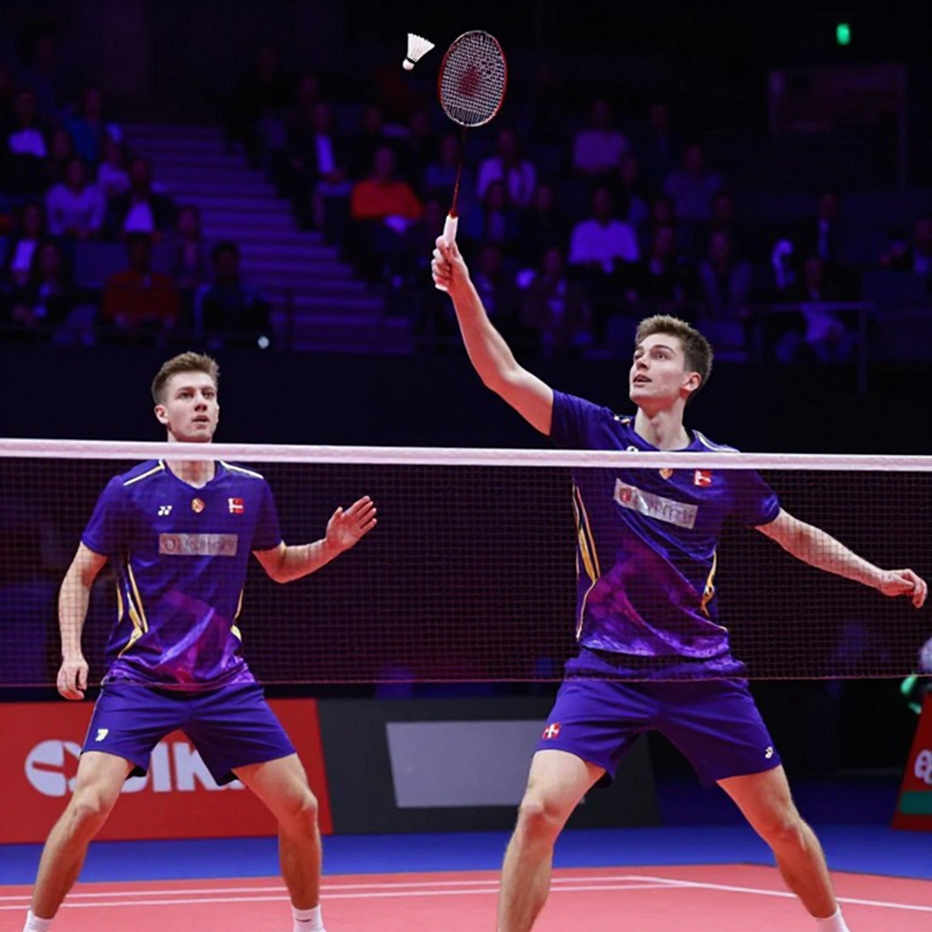
The original analysis describes the quarterfinal against Japan as India's "first major test". I agree, but for a different reason than the one given.
Japan is named with a squad that has singles depth — rally-control players, the Kodai Naraoka type, who stretch rallies, grind opponents with clears and drops, and wait for an opening. India plays the opposite way: attack first, hunt points quickly.
This is a classic stylistic clash. And it carries a physical variable no analysis mentions: rally length. An attacking player against a control player must accept longer rallies. In a tie format, where a match can go three games, that accumulates into a fitness problem — especially for players past their peak.
I have no smash-speed data, no deciding-game win rate, no head-to-head figures for any pair in the original piece. I looked. There are none. That is the biggest gap in the entire projection: it carries not a single performance metric. Every claim about "considerably more experience" rests on reputation, not on form.
Based on my experience watching team ties, one thing repeats: depth-heavy teams tend to win long ties, while star-led teams tend to win short ones. Japan is built to stretch.
And here is the point the original analysis skips: the quarterfinal against Japan is not a stop on the road — it is a trapdoor. If India loses there, the entire "path to the final" becomes meaningless. Japan does not only have singles depth; they also have the home stands. In badminton, home advantage is not in the court surface — it is in the noise after each point, in the crowd's surge, in the way a home player is refuelled exactly when the game tightens.
I once sat in a packed arena of home fans during a team tie. What I learned is not that the crowd scares the opponent — it is that the crowd makes the home player believe in shots they would not normally dare. That is a variable no spreadsheet can measure, but it exists.
The semifinal against China: depth beats stars
If India gets past Japan, they meet China — under the original script.
This is where India's two-pillar model hits its hardest wall. China does not have two stars — they have a system. Their depth spreads across all three singles and two doubles. Such a team does not need anyone to shine; they only need no one to collapse.
The original analysis says it plainly: India "cannot rely on one or two players". That is a tactically correct line, and it negates the entire rest of the article. If you cannot rely on one or two players, then your model — built on exactly one or two players — has a structural problem.
Depth is what beats stars in a team-tie format. This is not an emotional claim. In a knockout event, one star can win one match. But in a five-rubber tie, you need three points from five different sources. China has five sources. India has two solid sources and three open ones.
But — and this is where I must be careful — I have no head-to-head data between the Indian and Chinese players. I do not know how many times Lakshya Sen has met Shi Yuqi, Li Shifeng or Lu Guangzu, or how many he won. Without that data, I cannot say "China will win". I can only say: the structure tilts toward China. And in sport, structure does not decide results — it shifts probability.
The hypothetical final: a strike at the certain point
This is the most interesting part, and the one the original analysis handles most casually.
Three names are given for the hypothetical final: Indonesia, Malaysia, Chinese Taipei. All three are judged by reputation, not by lineup. Not a single Chinese Taipei player is named — a "dark horse" claim with no horse.
But Indonesia is a special case. Indonesia is strong in men's doubles. And men's doubles is exactly India's certain point — the Satwik – Chirag pair.
If India meets Indonesia in the final, one simple thing happens: their certain point stops being certain. India's strongest pair must face one of the strongest doubles nations in the world. That forces India to win three singles rubbers to take gold. Three singles rubbers, with one peak pillar and two veterans past their peak. That is a far harder equation.
I call this the pillar paradox: your strongest point becomes the most targeted point, and when it is neutralised, you do not lose one rubber — you lose an entire structure.
Malaysia is a different case, leaning toward singles. But if Malaysia reaches the final, they too clash directly with India's singles pillar — meaning India cannot count on the opponent being weak exactly where India is strong. No final scenario is easy for India.
The wider picture: one superpower and a chaotic second tier
Placing India into the full landscape, I see a clear structure.
The first tier has one name: China — depth in every discipline. The second tier is a crowded group: Indonesia led by doubles, Japan balanced and at home, India led by stars, Malaysia led by singles, Korea led by doubles. The third tier is the chasing pack, with Chinese Taipei as a name capable of causing disruption.
In this structure, India sits firmly in the second tier. They are level with Japan and Malaysia, but structurally behind China. India is a two-pillar team: they can beat almost anyone if both pillars fire, but they are fragile if one pillar is neutralised.
And here is a methodological observation: squad-evaluation models tend to overvalue young potential and undervalue the chemistry of a whole collective. In this case, Ayush Shetty is a young name included as a signal of generational handover — but there is no data on his ability at team-tie level. Meanwhile Prannoy and Srikanth, two players past their peak, are the ones holding the swing point. That is a trade-off no spreadsheet can resolve, because it lives in the dressing room, not in a column of numbers.
The contrarian angle: when "certain" is a dangerous word
There is one line in the original analysis I read again and again: the Satwik – Chirag pair is described as a "near-certain point".
I do not believe in certain points. I believe in probability.
A pair that won the Asian Games can win nine of ten matches. But in a knockout tie, that tenth match is the only one that counts. A ninety-percent probability sounds beautiful until you realise you only get to play once.
And there is one more thing the original analysis does not say: it does not say which doubles rubber India will field Satwik – Chirag in. If they concentrate strength on one pair, they lose the other. If they split the pair, they lose the certain point. This is a tactical decision no article mentions, and it could decide the whole tie.
The original analysis also contradicts itself on the bracket. One headline names Korea in the semifinal. The body draws China. For a data person, this is not a small detail. If you are not sure who your semifinal opponent is, you do not have a path — you have a hypothesis. And an unverified hypothesis is not enough to build a plan on.
I suspect this contradiction comes from how the article was assembled: a general piece about "the bracket has been released", plus a separate India analysis. Two sources, two moments, one synchronisation error. That is a familiar pattern in the content industry.
When the media calls a journey destiny, I call it a probability distribution that has not been fully drawn.
What to track
Setting the projection aside, there are three things in the original piece I have flagged to watch.
First, the real bracket. If India's semifinal opponent is Korea rather than China, the entire premise of the article collapses. Korea is strong in doubles — once again, aimed straight at India's pillar. This is a signal to verify through the organisers' technical meeting, not through an article.
Second, who plays third singles. Prannoy or Srikanth? Both are past their peak. This is the swing point, and it is a coaching decision, not a data one. If a low-form player is chosen over an in-form option, India opens the swing point with its own hands.
Third, the form of Satwik – Chirag. If this pair dips or gets injured, India does not lose one point — they lose the whole model. No other pair in the named squad is there to replace that role.
I still remember the principle I set long ago: a single win can be luck, but a season is where probability exposes every truth. Here, we do not have a season. We have one tie, one chance, and a spreadsheet with many empty cells.
Data never tells a sad story. It only points out who is lying to themselves. And in this case, the one lying to themselves is anyone who believes a path to the final can be drawn without a single performance metric.
A thought for what lies ahead
The real question is not whether India reaches the final. The question is: when a sport builds a gold ambition on two names, what happens to everyone else when those two names do not fire?
For a data person, a reliable team — in football or badminton — is not the team with the highest ceiling, but the team with the highest floor. And in this Asian Games 2026 problem, India still leaves the answer open at exactly that floor. The team that fills that floor before the opening whistle is the team worth talking about, not only in Aichi-Nagoya, but across the whole cycle after.